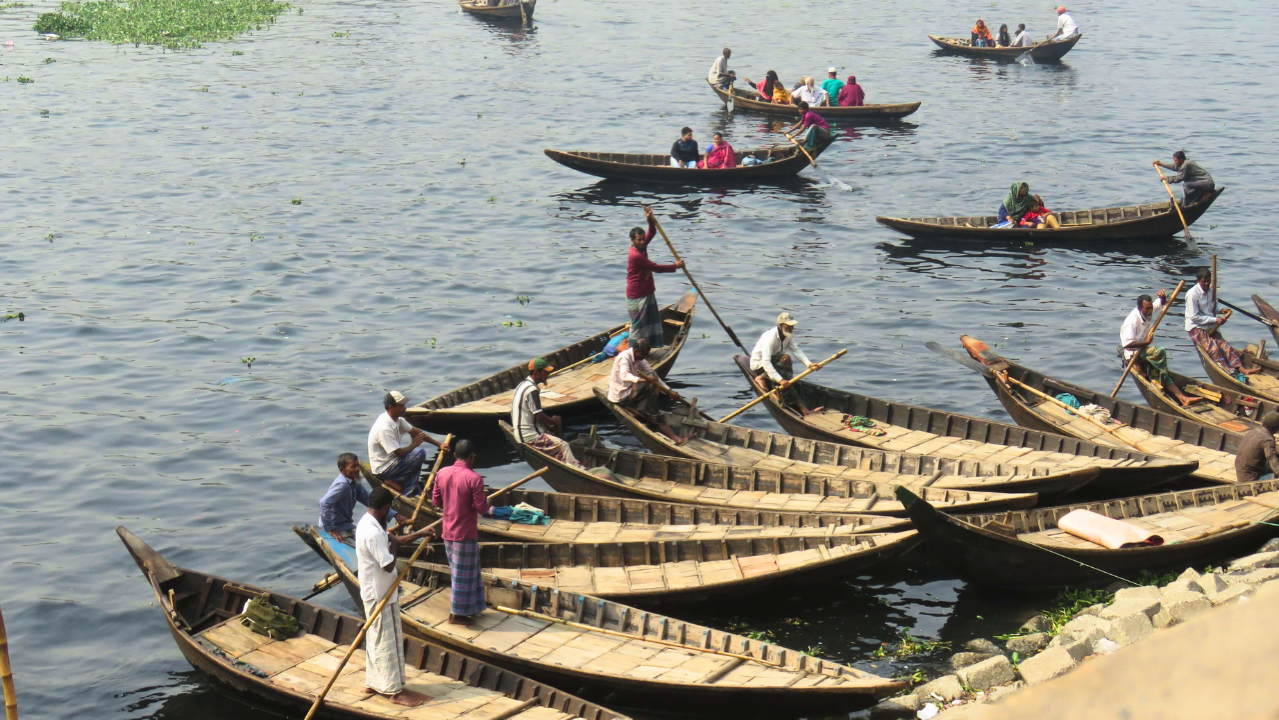

Walking holidays are growing in popularity as a more sustainable way to travel, reducing carbon footprints while redressing some of the balance between travellers, natural environments, and local communities. Ian Packham shares his memories of just such an adventure – using two feet to traverse Bangladesh at three miles per hour.
In the masterful A Time of Gifts, Patrick Leigh Fermor wrote: “On foot, unlike other forms of travel, it is impossible to be out of touch [of people].” Aircraft make it all too easy to avoid the cultures bypassed by altitudes of 30,000 feet. Trains guide you silently past back gardens, and motor vehicles, less than silently along arterial routes cutting through communities. It’s only pavements and footpaths that lead – at the same pace as bees, birds, and small mammals – to front stoops, school gates, market stalls and village halls. They are the open windows into the soul of a country.
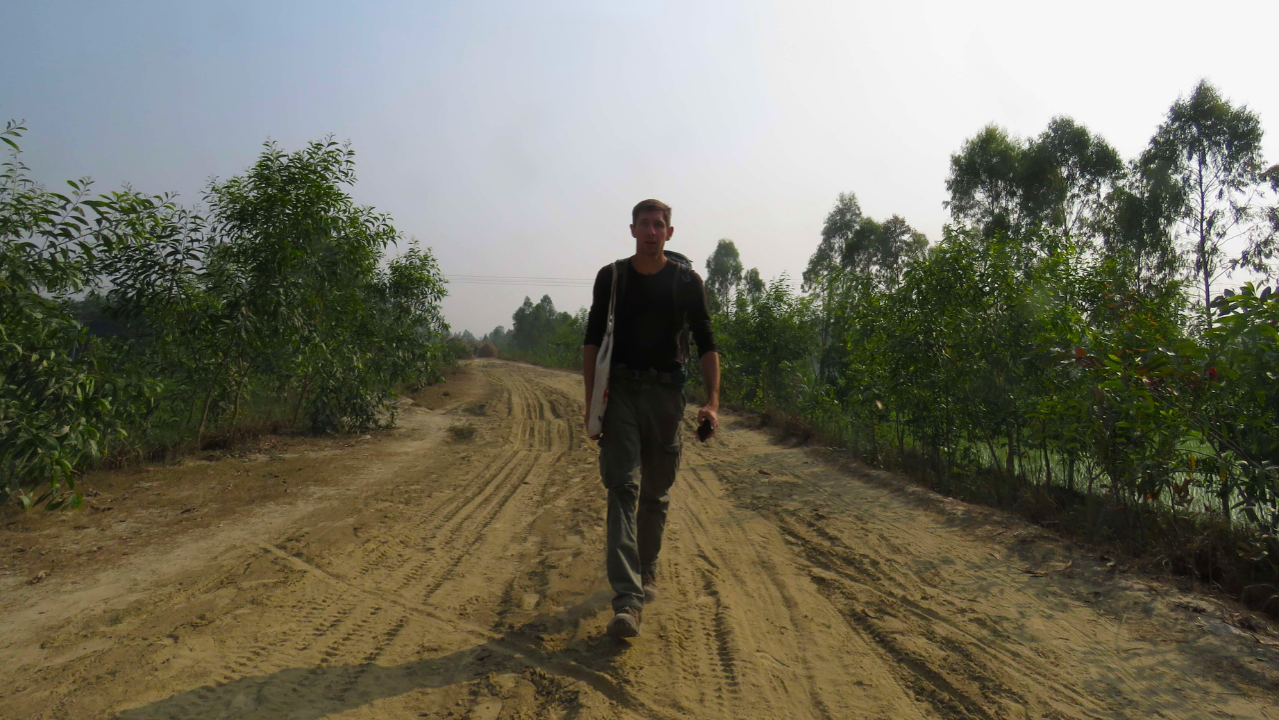
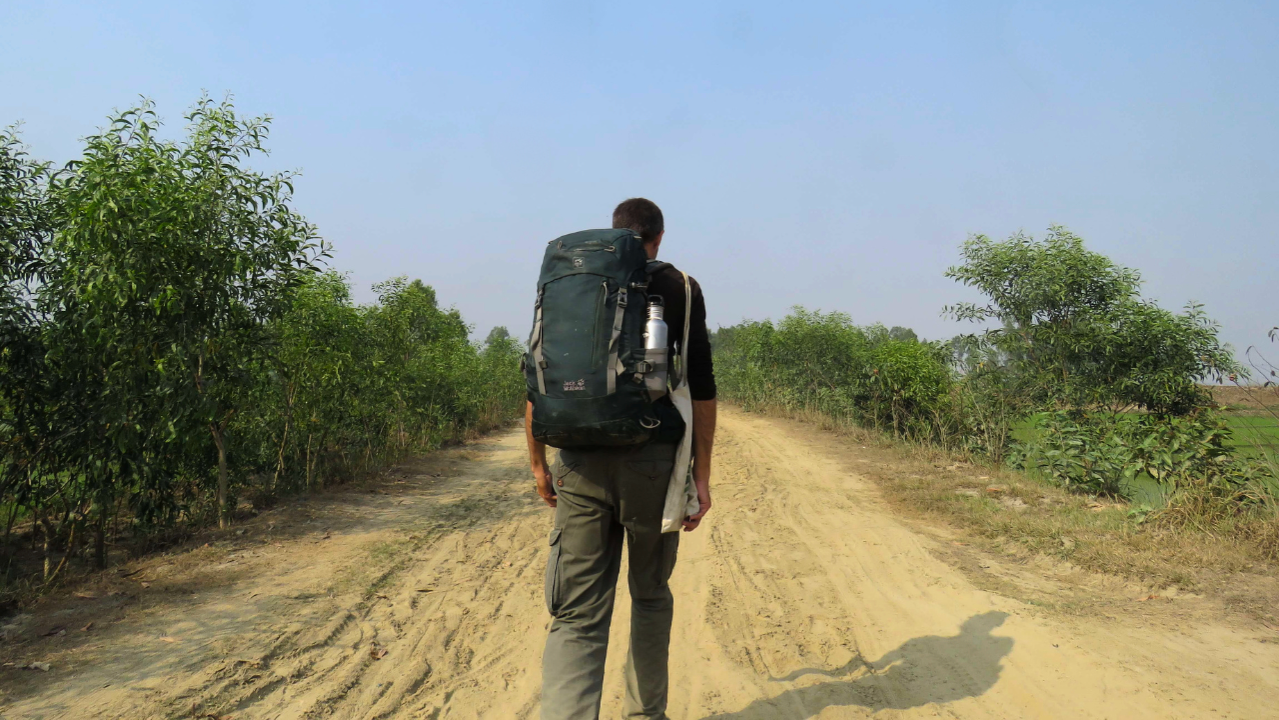
I convinced myself of this as I embarked on my longest-ever journey on foot, 700 miles (1,000 km) from the southernmost to the northernmost points of a country where I had no contacts and spoke nothing of the language. With Bangladesh similar in size to England and Wales, it would be equivalent to walking the Trans Pennine Trail 2.5 times back-to-back.
Google Saint Martin’s, like I did, and you’ll either get the college or the Caribbean island shared by France and the Netherlands. There is another, accessible only by ferry and during Bangladesh’s dry winter.
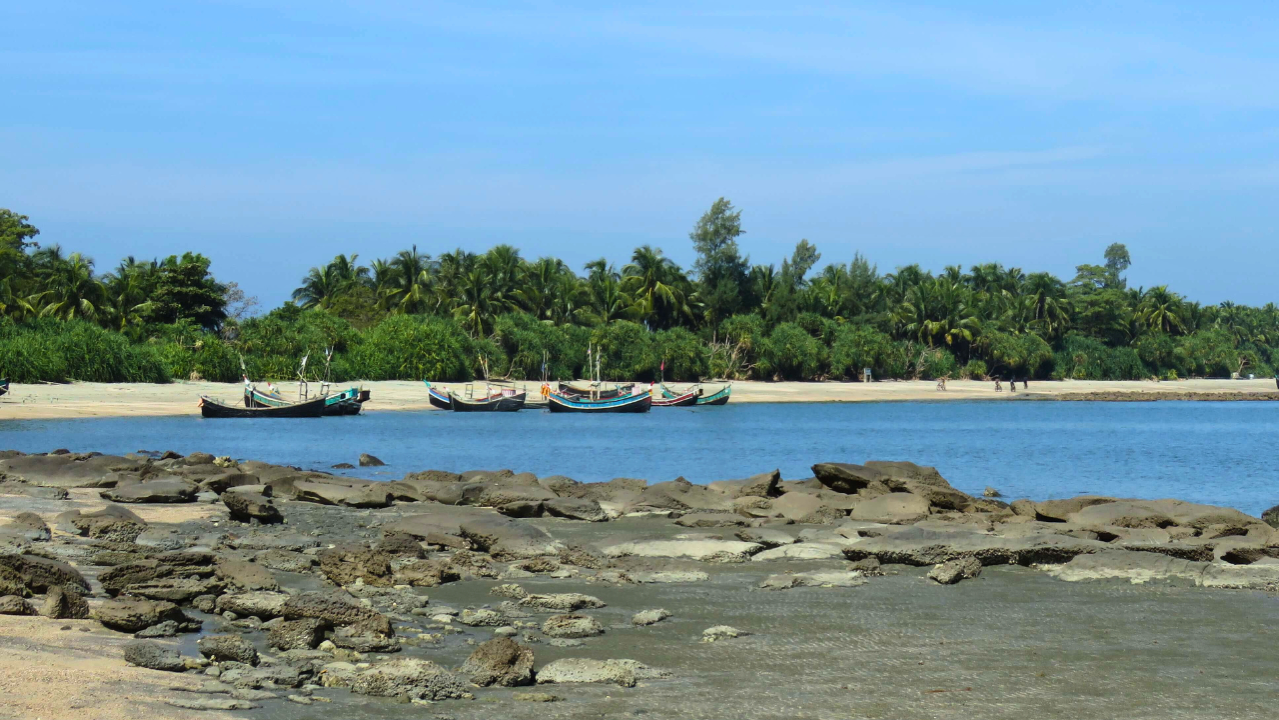
Not much more than sand banks in the Bay of Bengal, Saint Martin’s forms Bangladesh’s southernmost point. Already cleaved into two twice a day by the tide, it could be one of the world’s first casualties of climate change, pushing the communities that have lived here for a century elsewhere. But with 20% of Bangladesh at risk of rising tides in my lifetime, they’d be joining an estimated 40 million other climate refugees.
As I set foot on its soft foundations, the rising tide is already threatening to temporarily divide it, the connecting sand bar disappearing beneath an incoming flood of warm, ankle-high water as a naval vessel and coast guard cutter patrol the waters immediately offshore. Myanmar is just a few miles east.
At low tide, a single zigzagging island, still only three miles in length, is formed. There’s a car-free road made up of deep-red house bricks laid side on. Lined with chai stands, stalls hung with pungent dried fish, and a single-storey school where children chant by rote in imitation of their teacher, the bricks’ herringbone pattern reminded me of Dorothy’s passage through Oz.
But it’s the shoreline which forms the island’s main route from end to end. It’s the route taken by the hawkers carrying goods hanging from stout bamboo poles bending across their shoulders, the palm-frond baskets piled high with cheap plastic household items.
It’s the path of local fishermen mending their nets and crabs the size of a fingernail scattering to the protection of previously submerged rocks. They’re rocks that seem wholly unused to being above the waves rather than below them and appear out of place and alone as a result.
My walk is anything but a lonely one. Whether on the shores of Saint Martin’s, battling beside the traffic of Dhaka, or reaching the gates of India in the far north at Banglabandha, my solitude is regularly broken by spontaneous hellos. Rarely anything but welcoming, over my 44 days, they range from the standard fodder of school textbooks across the globe (‘What is your country? What is your name? Okay, thank you. Goodbye’) to shared compliments about strength.
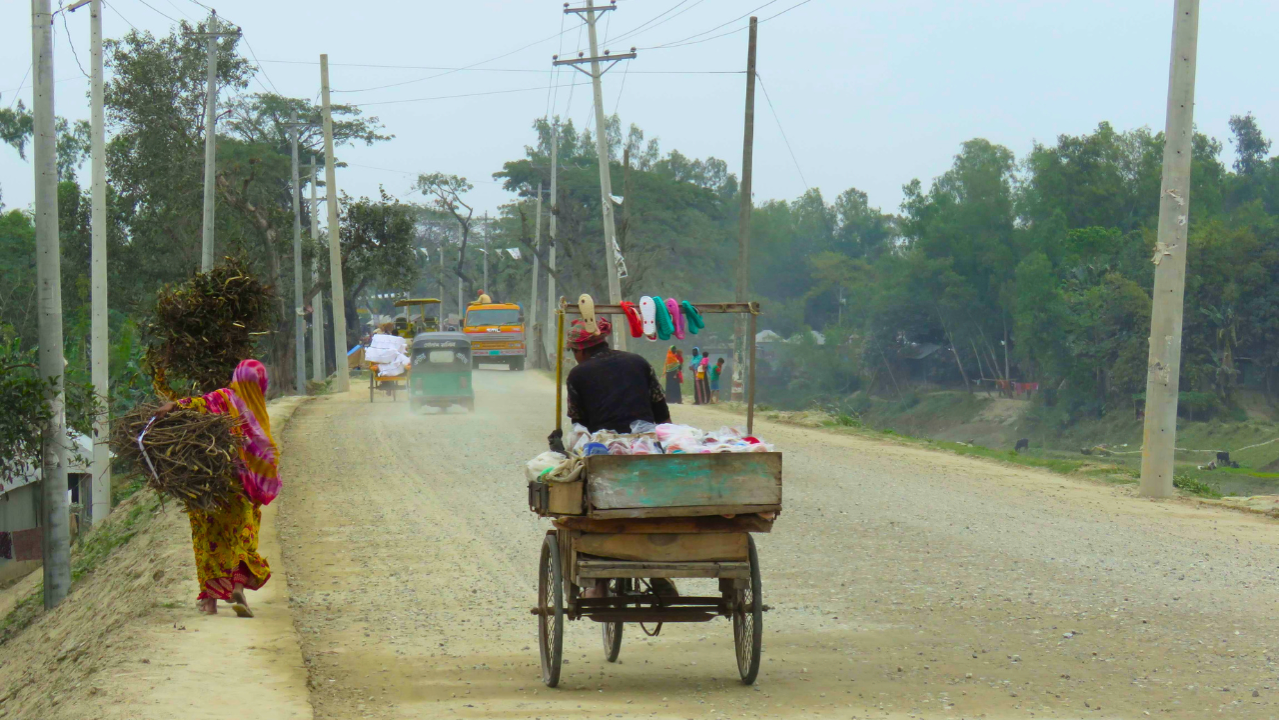
The latter comes from men resting between hours of hauling sand up steep river banks in baskets swinging from wooden yokes. They admire the power of my legs (‘no one in Bangladesh walks,’ they mime), and I wonder at shoulders bearing the dark, tough-to-the-touch scar tissue of years of strain.
Another day, a man says nothing more than ‘Bradford City?,’ his only English, before paying for my glass of chai; someone else offers a brief salam alaykum on passing, while a third rides alongside me on his imported motorbike for an hour and a half, recording our conversation with his smartphone. It’s that way I learn the latest cricket scores, teach a child the word beef, find a place to stay the night, and feel that in some way I am contributing rather than just taking – an accusation increasingly thrown at the tourist industry.
One of the most densely populated countries in the world, I could never be alone for long in Bangladesh, and I am grateful for that as a distraction from the counting of miles. I feel the hug and protection of a community guarding a guest, a community it’s impossible to be out of touch with thanks to a cheap pair of walking boots.
If you are passionate about hiking in the wild nature, check out our Naturalist Journeys page to discover other exciting destinations.
| Cookie | Duration | Description |
|---|---|---|
| cookielawinfo-checbox-analytics | 11 months | This cookie is set by GDPR Cookie Consent plugin. The cookie is used to store the user consent for the cookies in the category "Analytics". |
| cookielawinfo-checbox-functional | 11 months | The cookie is set by GDPR cookie consent to record the user consent for the cookies in the category "Functional". |
| cookielawinfo-checbox-others | 11 months | This cookie is set by GDPR Cookie Consent plugin. The cookie is used to store the user consent for the cookies in the category "Other. |
| cookielawinfo-checkbox-necessary | 11 months | This cookie is set by GDPR Cookie Consent plugin. The cookies is used to store the user consent for the cookies in the category "Necessary". |
| cookielawinfo-checkbox-performance | 11 months | This cookie is set by GDPR Cookie Consent plugin. The cookie is used to store the user consent for the cookies in the category "Performance". |
| viewed_cookie_policy | 11 months | The cookie is set by the GDPR Cookie Consent plugin and is used to store whether or not user has consented to the use of cookies. It does not store any personal data. |